
Why Gay Men Specialize in Cruelty
We know what we do to each other. The honest reason we keep doing it is the part we don't say out loud.
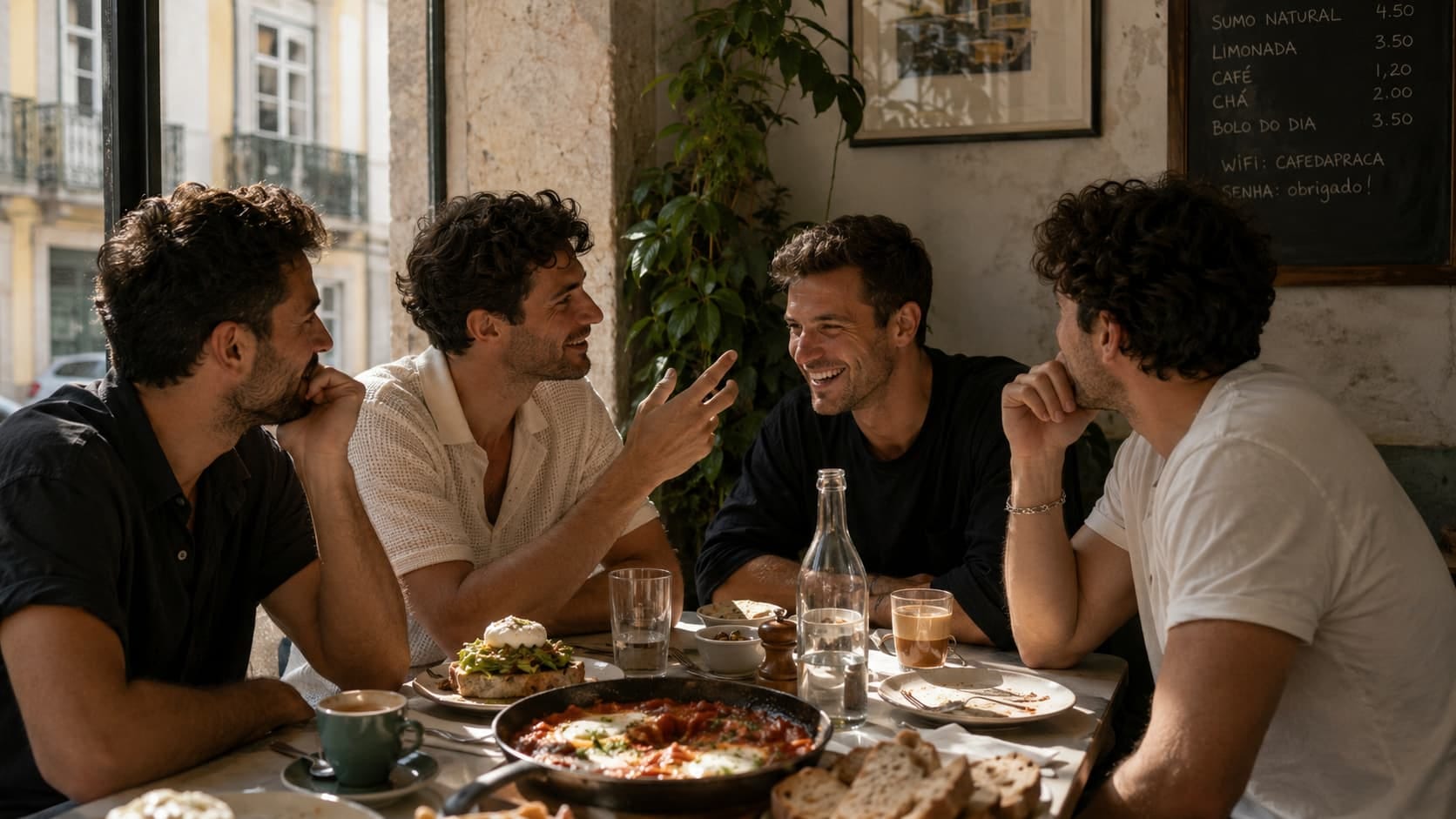
Four of us at brunch on a Sunday in Lisbon. The shakshuka is good. Someone mentions a man a couple of us went on dates with separately, years apart. The first observation lands. Then the next one. The voice doing it has a particular quality. Witty. Precise. The kind of read that makes everyone at the table sit up because the language is so good.
By the third minute, the man being talked about has been comprehensively dismantled. His outfit at a wedding. His career trajectory. The thing he does with his mouth when he’s nervous. The way he writes captions on Instagram. The dinner at his apartment that everyone privately thought was sad.
We laugh. We laugh a lot. The performance is excellent. The man is not here to defend himself, and even if he were, the rules of the exchange are clear. You appreciate it. You add to it if you can. The technique gets filed away for next time.
Walking home, I notice I feel slightly worse than I did before brunch. The discomfort is about the conversation, and specifically about how good we all were at it.
What we’re actually doing
If you’ve spent any amount of time inside gay male social life, this scene is familiar. The brutal read is one of the most stable institutions we have. It happens at brunch, in group chats, on apps, at funerals. It’s how we audition for each other, mark insiders, discipline taste, and signal that we know the rules of the room. We have other words for it. Shade. Taste. A good eye. Receipts. The framing matters, because cruelty would be embarrassing to engage in this often. Sport is fine. Sport, we can do all day.
What we’re doing, underneath the framing, is converting anger into status.
The mechanism is simple, and once you see it you cannot un-see it. As gay boys, anger directed at the people who actually wounded us was lethal. You could not be angry at your father. You could not be angry at the teacher who looked away. You could not be angry at the boy at school who said the word, or at the institution that let him say it. The hierarchy was clear. Anger sent up the chain came back as punishment, withdrawal, or worse. So the anger had to go somewhere else.
It went sideways. The only available targets were other gay boys, and later other gay men. They had no power over us. Anger directed at them came back as nothing, or sometimes as more anger we could feed on. Lateral hostility carries the lowest cost of any anger we could express. Oppressed communities have done this for as long as oppression has existed. We did it more efficiently than most, because we had practice from very young and very few other places to put what we were carrying.
I wrote about the compliant side of this adaptation in The Nice Gay Contract. That contract is the fawning version: making yourself smaller and more agreeable to avoid being the target. This piece is the other half of the same adaptation. When you’re done being small, when the anger has built up past what compliance can contain, you need somewhere to put it. The community provided that somewhere. It provided each other.
How the community formalized it
This is where it stops being a wound and starts being a culture.
The community did more than tolerate lateral cruelty. It built infrastructure around it. The bitchy queen archetype. The reading culture in ballroom and its drag descendants. Masc4masc filtering. The body-type hierarchy on the apps. The bouncer aesthetic of who gets seen at the bar and who gets looked through. The group chat as forum for dissecting absent friends. Pop culture absorbed and broadcast this back to us as charm.
Reading another gay man with style became a credential. Doing it well was admired. Doing it badly was punished. To be inside any sufficiently gay social space, you had to demonstrate fluency. The exchange rate was clear. Anger converted into cleverness, cleverness exchanged for status, status protecting you from being the next target.
The reason this system is so stable is that it solves multiple problems at once. It discharges the anger we have nowhere else to put. It buys us social standing in a community that runs on hierarchy. It pre-empts our own rejection by allowing us to reject first. It signals belonging through fluency in a shared language. As long as someone is being dismantled, it isn’t us.
Most of the cruelty operates in the implicit register, which is why even men who consider themselves kind participate in it without noticing. The eye-roll at the man trying too hard at the bar. The internal scoring on a date before he’s finished his first sentence. The quick read of a stranger’s photos that locates him on the hierarchy before you’ve decided whether to reply. In the moment, all of this feels like discernment. The discernment is the cruelty in a costume the wearer has agreed not to look at directly.
Why we don’t want to stop
Here is the part the conversation about gay men’s behavior usually skips.
We see it. Most of us see it clearly. When we talk privately, when we’re tired, when we’ve had one drink past where we should have stopped, we can name what we do to each other. The reads, the rankings, the cold gaze, the quick scoring of strangers before they finish a sentence. We know.
We keep doing it anyway, because the alternative is worse.
The alternative is earnestness. Warmth without irony. Complimenting another gay man on the thing he’s insecure about and meaning it. Being the person at the table who doesn’t laugh when the read starts. Posting something sincere and letting it sit there without protective hedge. Liking what you like without checking first whether liking it would lower your standing.
Earnestness reads, in most gay spaces, as low-status. As desperate. As the affect of a man who hasn’t figured out how to protect himself. The men who maintain it openly are admired in theory and avoided in practice. We talk about wanting more of that, and then we go back to the brunch table. At the brunch table we have a role. We are good at the read. The skill we developed under conditions we did not choose has become the thing that makes us legible to each other.
To stop participating means giving up a credential we spent decades earning. It also means feeling the anger we’ve been routing all along, and feeling it somewhere it actually belongs, which is mostly unreachable now. The men who hurt us are mostly out of reach. Some are dead. Others are still living and just as far away as they were then. The institutions are too large to confront. The childhood is gone. So we keep redirecting, because we have nowhere else to redirect to, and because redirecting works.
The cruelty toward each other also serves one more function, which is the one we name least. Every time we dismantle another gay man, we are rehearsing the gaze we use on ourselves. The eye that finds the flaw in his profile is the eye we run over our own bodies in the mirror. We need each other as practice targets to maintain the surveillance we run on ourselves. The two operations are the same. Stop being able to see what’s wrong with him, and you risk being unable to keep seeing what’s wrong with you. The discipline depends on the practice.
Every time we dismantle another gay man, we are rehearsing the gaze we use on ourselves.
What it costs
We are, as a group, exceptionally good at reading each other. The skill is real. It produced some of the funniest people I’ve ever met, and a culture of social observation that does, in moments, feel like belonging. None of that is fake. The cost runs alongside it.
The cost is that we cannot trust the rooms we built to protect us. The community designed as refuge operates internally on the same logic as the world that drove us into it. The hierarchy is just rearranged. The discipline is the same. We treat each other with a precision of judgment we would call abusive if a straight institution treated us this way, and we call it culture, because we have to call it something, and culture is more flattering than what it actually is.
Most men I see in my online therapy practice arrive fluent in this language. They want to stop running the read on themselves. They have not yet considered that they cannot stop running it on themselves while they are still running it on every other gay man they meet. The operation is unified. You give up both, or you keep both.
Most do not want to give up both. Not yet. The cost of stopping is higher than the cost of continuing, and the cost of continuing is mostly invisible because we’ve all agreed not to look at it.
We see it. We keep doing it. The story where we are only the wounded is the one we prefer. It asks less of us than the story where we are now doing the wounding.w
If a particular face came to mind while reading this, you don’t have to send it. I’m curious whether the recognition arrived for you, and where in the piece it landed. Reply if you want. I read everything.
Something keeps repeating.
You just can’t name it precisely enough to change it.
If someone came to mind while you were reading, send it to them. Not as accusation. As recognition.
— Gino
Gino Cosme is a gay therapist writing for gay men who are done performing.
New essays are always free. Paid subscriptions hold the archive open and keep the work independent.
All examples in this piece are composites drawn from patterns observed across therapeutic work with gay men. Details have been altered to protect confidentiality. No single story represents an individual person.
This newsletter is for educational and informational purposes only. It does not replace therapy, diagnose, treat, or prevent any condition.


