


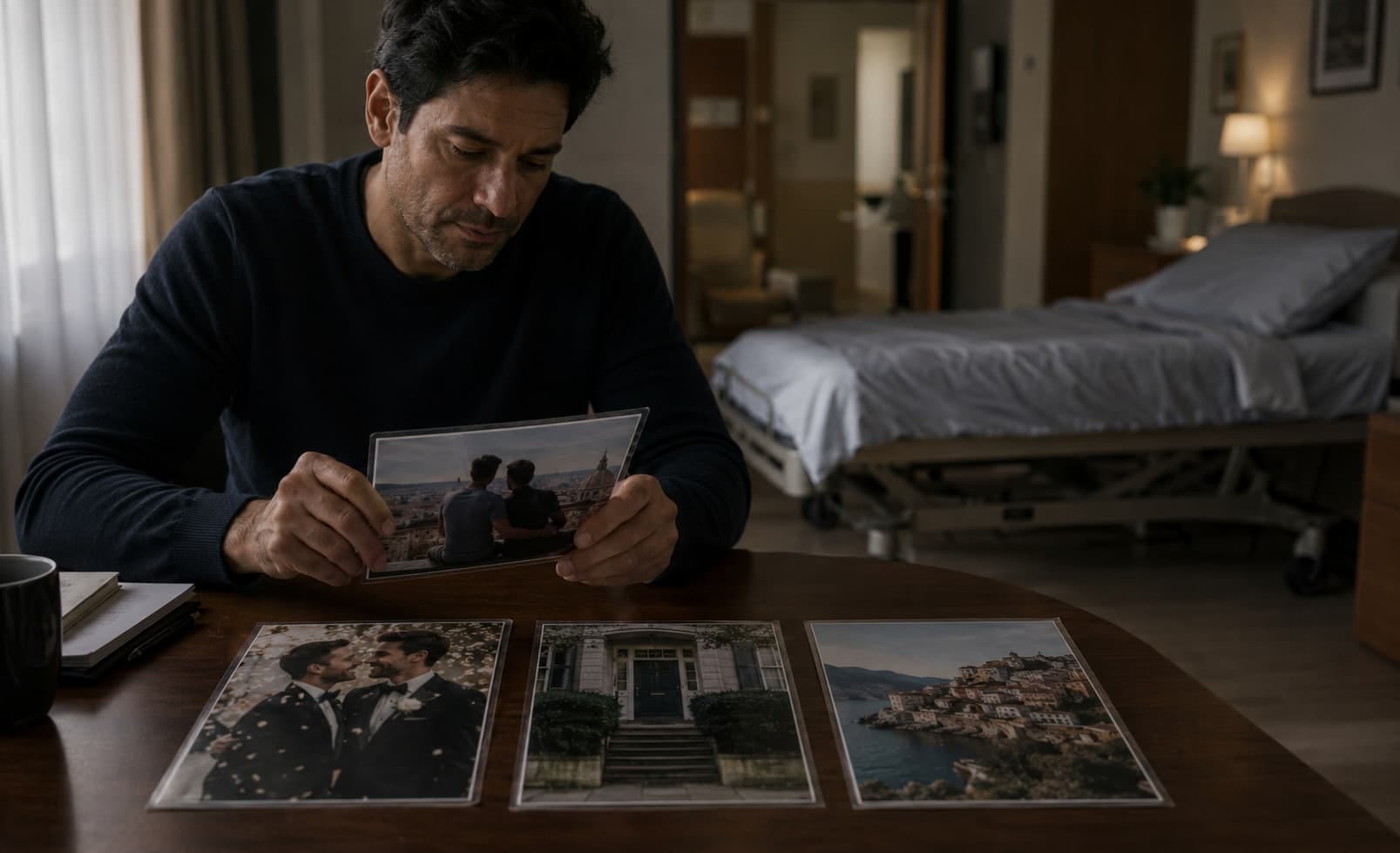
The morning before his husband was moving into an assisted living facility, Daniel spent an hour or two laminating three photos: One was of their wedding. The other was the front of a house that they bought together. The third was the trip to South Africa they did the year before the diagnosis.
He wasn’t doing this because he wanted to decorate the room. After all, this is a man who regularly suggested how I should embrace more of a minimalistic style in my office.
Rather, what he wanted was for these three photos to be something that people saw when they entered his husband’s room: something that would immediately say to anyone who walked in that a husband lived here.
I wouldn’t have been able to write this composite without pointing to what some would call “progress.”
Some gay men get married because it’s the “obvious” next step in their relationship. Others get married because it’s almost an expectation from family, friends, and society. And then there’s a third reason why gay men get married: the legal reason.
When Daniel and his husband got married, they became each other’s next of kin. This allows Daniel to sign his husband’s forms and avoid waiting for permission from the nurse at the front desk to enter his room. It alleviates the tiresome fighting to be with the person you love most. However, marriage and the legal system still leave a lot to be desired once Daniel’s husband is admitted.
While the paperwork recognizes Daniel as a spouse, systemically, little has changed with the people who staff the day-to-day operations. Very few healthcare workers have been trained on how to engage with same-sex couples. Simple things like asking who manages the medication and who manages daily meals become awkward topics of discussion.
There can be days when you arrive to visit your partner and the new nurse on duty asks who you are and mentions that only family members are allowed. And there can be days when you help your partner with meals, and you get that one second extra look from the other person in the room.
By the time you reach the age that Daniel and his husband were in their 60s, you personally don’t think much of it. After all, this is something that they’ve had to live with all their lives.
It does beg the question: why, at this stage of someone’s life, do they still feel like they’re under the microscope?
This experience is not shared by all gay men. Someone in his seventies with a history of hiding for so many years experiences something different from someone in their forties who has lived a life expecting people to treat him as an equal.
Sometimes the gay man who lives in the city might have an LGBTQ-friendly healthcare facility to go to, unlike the man who lives three hours away from the nearest medical facility. And while money might be able to buy a private room and not having to be on the waiting list for too long, it can’t guarantee you’ll have staff who know they shouldn’t call your husband of 30 years a friend.
Race can make this more challenging. I’ve worked with black elderly gay men who have and do struggle with various health challenges. Some with HIV and diabetes and others with health concerns typical of men of a certain age. What stands out is how systemic challenges still follow them. I remember a few of them sharing how they had lived a life of being judged, suspected, and managed by institutions. These experiences end up shaping how they experienced the care facilities they visited in ways that don’t get taught in medical school.
A Black man in his 70s is someone who lived through decades of segregation and, when going to a medical facility, was like entering a system that saw him more as a subject than a human being. It’s easy to forget that, depending on where you lived, elderly gay men in their 60s, 70s, or 80s lived a life where homosexuality was still considered a mental illness. These men carry with them the weight of being rejected by their family, church, and community. They are men who have learned to conceal who they are for the sake of safety.
There’s this automatic assumption that when you enter a care facility, you are a straight, white, middle-class man who has a loving family and a caring wife. Staff have been trained on LGBTQ inclusion. But it’s often the shallow kind, dominated by rainbow stickers, the correct use of pronouns, and assuming that queer elders are white by default.
When Daniel laminated the three photos the day before his husband entered the facility, he was also practicing his lifetime of experience on managing how people perceived the two of them. It’s a survival strategy that reappears, and it can easily be misread by institutional default thinking.
The most extreme version of an equal treatment is found amongst the men who don’t have a Daniel in their lives: men who didn’t partner with anyone, or who have outlived their partner or husband, or those who don’t have adult children to check in on them either through a Sunday phone call or by visiting where they’re at.
I’ve worked with men in their 50s and 60s who have told me how they have put off discussing this topic, either at home or in therapy. There’s a discomfort in facing a reality and being confronted with the void that exists in queer elderly healthcare.
As a gay man myself, I think about this and how it will affect my husband and myself. We’re not at retirement age. But at some point that day will come. Neither of us truly knows who will show up long term. It’s an uncomfortable thing to admit in a post that is meant to be useful, but it’s also the truth.
As much as I would like this to be a post about how far we have come, the reality is gay men are aging, and the care institutions that we will encounter are not designed with our needs.
Robert Burns’ Scots-language poem “To a Mouse” is a metaphor for what I have heard so often. Gay men who have built their houses, their environment, and a place of safety. They have all sorts of security, everything is wonderful, and then, one day, something comes along, and the whole thing comes crashing down.
Do what you can to avoid this.
Find out if there is any legal way to secure your interests. It’s important to become aware that so many people put this off. And end up in the clutches of the medical system, which is no alternative. Documenting this is the single most important thing you can do now.
Where do you start?
Take control of how you want to be treated. Document things like whether you explicitly reject artificial feeding, whether you want to be placed on a mechanical ventilator, breathing machine, and kidney dialysis, and explicitly assert that you don’t want to go into any facility and would rather be treated at home.
A few clients have told me they even included not to have a spiritual adviser enlisted and not wanting any medication or medical interventions that minimize physical or mental pain due to illness or incapacity.
Failing to have these in black and white puts pressure on your husband or next of kin, during a time that is already stressful. Your life is at risk of being managed by default standard procedures built for straight men who have functional families.
A chaplain showing up, estranged family members making decisions, being kept alive to safeguard the facility legally, or being under-medicated due to conservative medical practices.
And a little bit of advice an attorney friend once told me. Get it signed and witnessed, and send a copy to your doctor and a copy to your husband or partner. Just because the system doesn’t prioritize some in the queer community doesn’t mean you can’t make them act in your best interests.
None of that will fix the gap we still experience. But it does mean that the man or people you love won’t have to build a case of who you want in the room or making important decisions, like Daniel did, with his laminated photographs.
If this is a question you’ve been avoiding too, I’d like to know. Reply to this email and tell me what part landed.
Until next week,
Gino x

If someone came to mind while you were reading, please send this to them.
Gino Cosme is a gay therapist writing for gay men who are done performing. New essays are always free. Paid subscriptions hold the archive open and keep the work independent.
All examples in this piece are composites drawn from patterns observed across therapeutic work with gay men. Details have been altered to protect confidentiality. No single story represents an individual person.
This newsletter is for educational and informational purposes only. It does not replace therapy, diagnose, treat, or prevent any condition.
I just went through this experience, not as a patient, as a home caregiver, POA, and eventual manager of institutional care. He passed away this spring. I feel fortunate because, although our experience wasn't perfect, it was adequate—perhaps being in Canada made a difference.
The things I noticed:
People in management and health authority leadership get it. They have protections and policies in place. Problem is that they aren't the ones caring for LGBT elders on a daily basis. The disconnect there is obvious. We didn't have any anti-gay sentiment from caseworkers or nurses. The issue was more that they defaulted to hetero language: "did you have a wife?".
The one time I had an issue, it was dealt with promptly. A patient in a quad room was racist to some patients and called my loved one a "fa...t". I went immediately to the floor manager and reported this. It was taken seriously and they were moved that day. I considered this an adequate response given the lack of available rooms.
A legal health directive and POA benefits any person, but for LGBT folks it's a must. I constantly told health workers I was chosen family and they got it. The POA and health directive was a safety net I didn't use much, and when I did, I felt it was more about documentation that not respecting patient realities. Without those documents, I wouldn't have felt as assured that everyone was on the same page.
Although I paint a tolerable picture, I wouldn't say that facilities we encountered are gay positive. More specifically, I would say they have policy in place and are gay tolerant with the intention of being gay positive. They didn't have event programming for LGBT folks, which may be because patients didn't want to out themselves rather than not being willing.
Meanwhile, we watched Heated Rivalry in his room and didn't turn it off when staff entered. We knew any negative reaction would be kept to themselves. Also, he was about out of "fucks to give." ;)
This one really made me think. I am 57 now, closer to 60 than 50, and aging has become something I think about very differently than I did even ten years ago.
I am an openly gay man, and I have lived my whole life openly. I have never believed that being gay should define everything about me, but it is absolutely part of who I am and part of the life I have lived.
I also know caregiving from the other side.
I spent the final months of my husband Andrew’s life caring for him when he was bedridden. I never left his side. When you love someone and suddenly become their caregiver, dignity, patience, compassion and simply being there take on completely different meanings.
That experience changed me.
Now I find myself thinking about what happens when people like me become the ones needing care.
Growing older should never mean going backward. No gay man or woman who spent decades becoming comfortable with who they are should reach their final chapters and suddenly feel they need to hide again just to feel safe, respected or properly cared for.
But I also think good elder care ultimately comes down to something even bigger than labels.
Human dignity.
Know the person. Know their history. Know who they loved. Understand the life they lived before they became the older person sitting in that room.
There is an entire lifetime inside that person.
One day that person will be me.
One day it will be you.
How we care for people at the end of their lives says an awful lot about who we are while living ours.