

Why Gay Men Turn Money Into Armor
What it costs when protection becomes your entire personality.

Gino Cosme is a gay psychotherapist with over a decade of working with gay men. This is Unfiltered Clarity, a weekly essay on the patterns gay men live but rarely name.
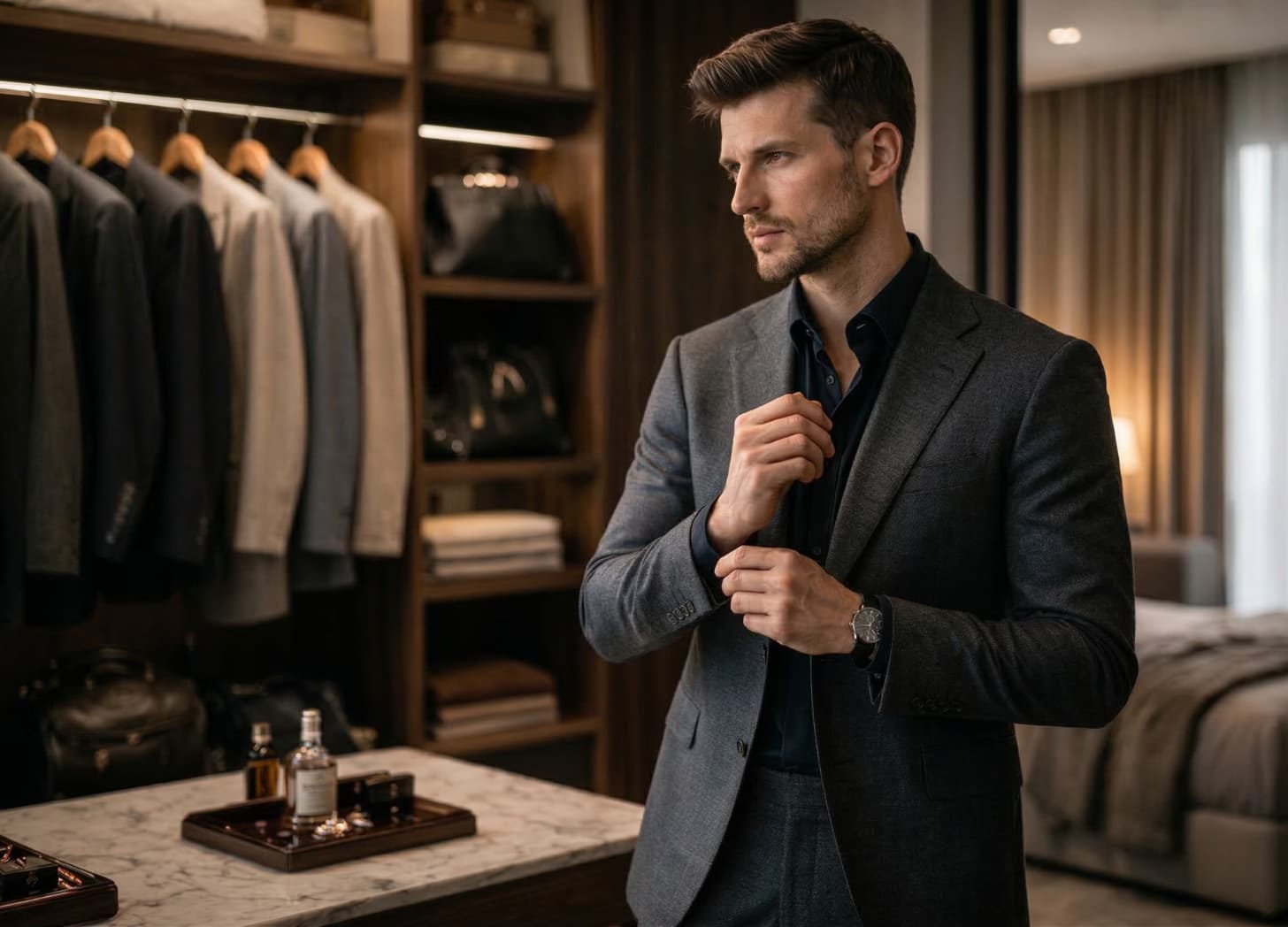
The invitation came through a mutual friend. A rooftop party in a part of the city where the air itself feels more expensive. Four hundred euros for a ticket. A queer charity event, technically. The gay men there had the specific ease of men who have either never calculated whether they could afford the bar tab, or who calculated it once, years ago, and have since built an identity around not having to.
I stood near the edge with a drink I hadn’t paid for, watching.
Something more confused than contempt, which surprised me. Because some of these men had been where I had been. Some had grown up hiding. Some had survived families that would have preferred them gone. And now they were standing in Loro Piana and talking about their second properties in Comporta with the same fluency that I once learned to talk about football. Fluency acquired for survival. Just pointed in a different direction.
That’s what I couldn’t stop turning over. The fluency hadn’t changed. Only the currency.
When Safety Has a Price Tag
Here is the thing that goes mostly unsaid about some gay men and money.
Wealth, for many straight men, means more or less what it’s supposed to mean. Status. Security. Evidence of a certain kind of competence. It reads as an accumulation of success. For many gay men, money means all of that, and underneath it, something with an older pulse.
It means you made it out.
Poverty and queerness produce overlapping fears. The fear of being visible in the wrong way at the wrong time. The fear of needing something from people who do not wish you well. The fear of having your survival depend on the goodwill of a world that has already demonstrated its limits.
Gay men who grew up working class or economically precarious carry that double exposure without needing to be reminded of it, and money, when it finally arrives, lands as armour in a way it simply does not for people who were always expected to have it. I’ve written about the specific shape that takes in Shame and Safety. Money is one of the ways it resolves, or tries to.

The wallet becomes load-bearing.
This is why materialism in gay male culture has a different texture than materialism elsewhere. From the outside, it reads as vanity. The apartment in the right neighbourhood. The wardrobe assembled with a devotion that most people reserve for something religious. The gym body maintained with the discipline of someone running from something, which some of them are.
From the inside, it often feels like finally being allowed to exist without justifying it.
The apartment says: I have a right to be here. The clothes say: you cannot dismiss me. The body says: I survived, and I have the evidence. These are legible statements of self-protection dressed as aesthetic preference. They make complete psychological sense.
The problem is that armour worn long enough starts to function as identity. And identity built around protection against the old threat leaves very little room for what comes after the threat recedes.
What the Sugar Daddy Is Actually Offering
I want to work with this at its most concentrated expression, because the “sugar daddy” dynamic is where the psychology of money-as-armour becomes most visible, and most misread.
The cliché is contemptuous. Older wealthy man, younger attractive man, an arrangement where desire and money perform the fiction of not seeing each other. The cliché is also lazy, because it describes the surface while missing the mechanism.
When I have sat with younger men navigating these arrangements, the thing I notice is this: they are rarely talking about desire. They are talking about access. The wealthy older man is the private members’ club that wouldn’t have you. He is the dinner table where people discuss their summers in the way that assumes everyone has summers. He is, sometimes, the first person in a long time whose attention felt like it came without conditions.
I’ve sat with men who couldn’t afford therapy at full rate, who were simultaneously spending weekends in apartments that cost more monthly than some people earn in a year. When I asked what they got from it, the answers were almost never about sex. They were about being inside a life that looked safe. The assumption of safety. The furniture of safety. Waking up somewhere that the fear hadn’t reached yet.
The conversation about these arrangements defaults to exploitation, which is a real dynamic and worth naming. It’s also incomplete. Because the younger man is often doing something that makes complete psychological sense given what money came to represent in a life where its absence felt like exposure. He is not performing attraction. He is performing proximity to the thing he was told, implicitly and for years, that he couldn’t have. The wanting is real. What the wanting is actually pointed at is the question worth sitting with.
And on the other side: the older man who finally has the resources to be chosen. Who spent years being the one who wanted and was tolerated. For whom the dynamic is its own armour, the armour of being desirable enough to be pursued, which is a feeling that was in short supply for a very long time.
Two men using the same transaction to resolve two versions of the same fear.
That dynamic doesn’t stay contained to individual arrangements. Scale that up and you get gay communities that quietly replaced “you belong because you survived” with “you belong because you can demonstrate the right kind of survival.” Same armor logic. Just applied to a room instead of a person.
The men sorted out by that shift are experiencing something the language of queer community doesn’t have good words for: grief at being priced out of a space built specifically for people in their position, by people who no longer recognise the resemblance. I’ve written about that pattern in The Connection Paradox.
What’s worth naming here is that the sorting isn’t malicious. It’s automatic. Armor tends to reproduce the conditions that made it necessary.

The Thing the Money Was Always Trying to Buy
The men with money deserve more complexity than a villain reading.
Many of them clawed toward financial security the way they once clawed toward the city. With everything. Because the alternative was going back somewhere that had made its position on them very clear. The money is often still running the program it started in childhood: keep the wrong people out, keep the old fear at arm’s length, buy the version of safety that nobody provided for free.
That program made complete sense. It also doesn’t recognise when the emergency is over.
Here is the mechanism worth understanding. The protection system was calibrated during years of actual threat. It learned, with real precision, how to read a room for danger, how to perform the right version of yourself, how to accumulate enough of the right markers that no one could question whether you deserved to be there.
That system kept you safe.
It also kept running after the threat changed shape. And at some point, the armor stops being something you wear and starts being something you are. You can no longer locate the line between protecting yourself and being yourself, because the protecting has been continuous for so long that there is no self left that predates it.
This is what the accumulation is actually sustaining. The second apartment and the archive wardrobe and the body that is always one training block from complete: all of it confirming it is still intact.
The fear has a floor that wealth cannot reach, so the wealth keeps going, not because more is needed but because stopping would require knowing what you are underneath it. And that question, after this long, feels more dangerous than the original threat.
The intimacy problem follows directly. I’ve written about this in The Intimacy Threshold. Belonging, at its most basic, requires being recognisable. To someone else, and to yourself. What you’ve built makes you unrecognisable in exactly the ways that matter.

Someone gets close and they encounter the performance, the wardrobe, the achieved version, and something in you is waiting for them to find the problem with it. Waiting for the calculation you’ve always assumed other people are running. So you keep a distance that feels like dignity.
The belonging that would require being seen without it stays hypothetical. And the money, which was always a proxy for safety, turns out to have purchased the one thing that makes the original safety impossible to receive.
The tragedy is that the money worked. It bought real safety, in many cases. A life without the specific terrors of before.
The protection system that kept you alive can’t distinguish between the emergency that was and the peace that is. So it keeps running. And you keep accumulating proof of safety in a life where the thing you’re still afraid of stopped being real years ago.
The armor made complete sense when you built it. Understanding that it's still running is the first step toward choosing something different. That's what I work with in therapy for gay men across the UK and Europe, and in coaching for men in the US and Canada
If you recognised yourself in this, you're not alone in it. And recognising it is the first move toward something different.
Until next week,
Gino x
Where did this land for you? Reply with the line that sat somewhere in your chest, or the version of this you’ve lived that I didn’t name. That’s what I actually want to know.
I work with gay men in online gay therapy in the UK and Europe and in coaching for clients in the US and Canada. If something in this essay landed, that’s usually worth paying attention to. You can find out more about working together at www.psycosme.com.
All examples in this piece are composites drawn from patterns observed across therapeutic work with gay men. Details have been altered to protect confidentiality. No single story represents an individual person.
This newsletter is for educational and informational purposes only. It does not replace therapy, diagnose, treat, or prevent any condition.
Gino, An interesting read for this 80+ year old gay man. In many ways, when I take a closer look as myself and ask "Who am I?" I easily reply, "I just am." I recognize the armor of safety you discuss, the surveying the room to determine how to behave, etc but by now, I have been through so much, have analyzed myself so closely, and am now dealing with the usual end-of-liife, that I really can answer, "I just am! And that feels good." I never felt that I had to proove myself as a gay man with wardrobe, bank accounts, vacation homes, etc. I just worked towards those flags of success that any person might wave. Getting my college degree. Landing a good teaching job. My first apartment. My first car. Purchasing my first home. Trips to Europe. I guess that at the point that I was not noticing the bottom line on a charge slip or bill payment signaled that I had arrived. Not to prove anything to anyone else (except maybe by mother) but myself, gay or not! Just the other day I as I was moving the three or four grocery bags to my car, I realized I had no idea how much the groceries cost. That felt good. I am fortunate. Fondly, Michael
I had been searching for sugar daddies a couple years ago.
I was deparate for acceptance. I was broke (still am). I wanted to get out of my parent's place ASAP (still do but not as much LOL).
When I did find one and he even wired me money to prove he's real which was shocking, I felt 2 things—relief, and a chain.
I was relieved cuz of the money ofc. But the second one, it didn't hit me until a few days went by. I never met him in person, thank God, but he made me change my hair.
After a few days when I looked in the mirror a little longer than usual, I hated the way I looked and the way the hairgel felt on my head. All I wanted was an out. That's when the suffocation hardened.
I thought I'd feel safe, held, seen but I only felt the opposite of all that.
That's when I decided I'd rather stay broke and lonely if it meant I could stay true to myself.
I have never told anyone this.