
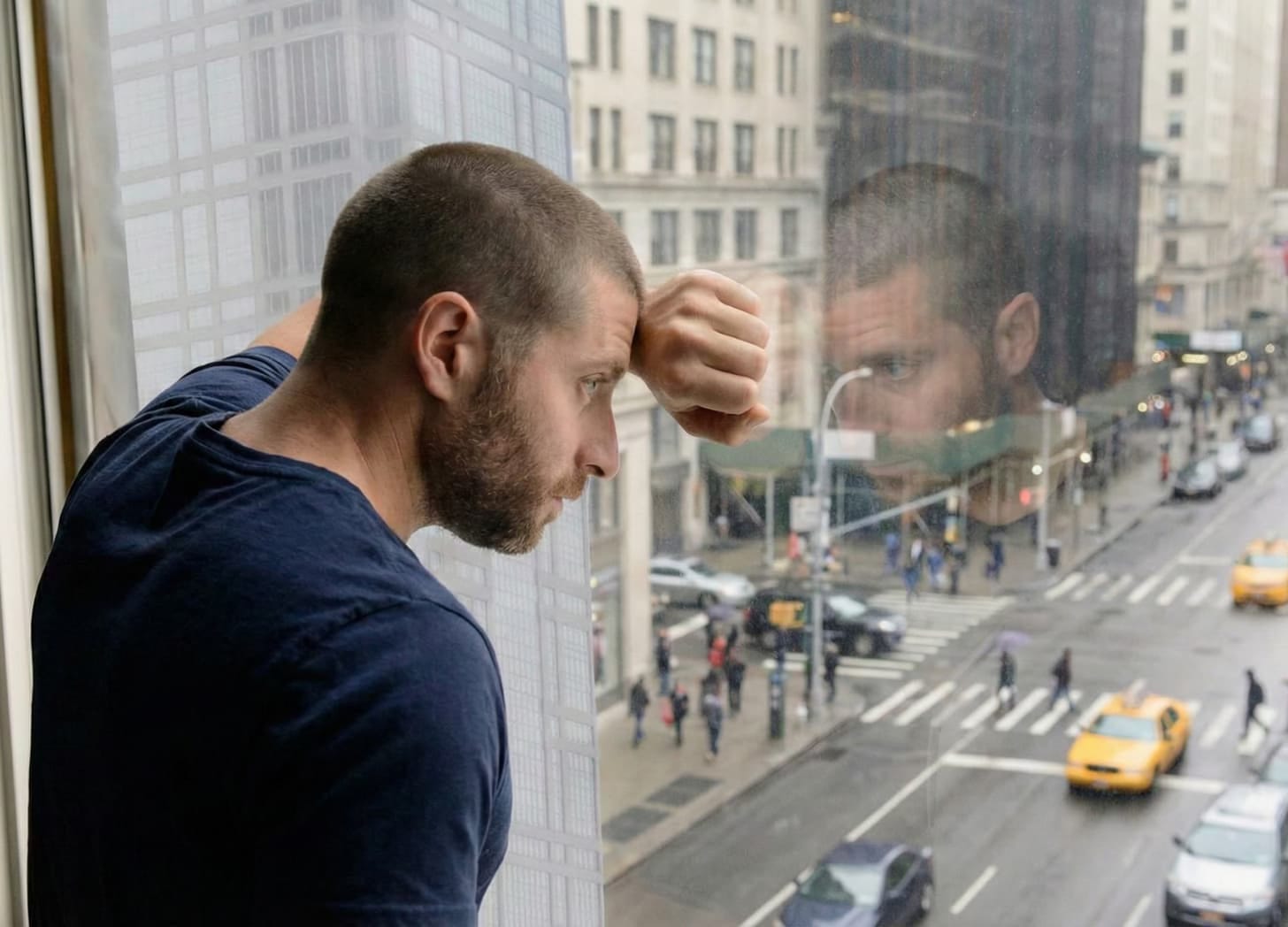
The Loneliness That Has No Name
Why gay men feel most alone when surrounded by people
His phone screen lit up during our session.
Three dating app notifications, two group chats, a Friday drinks invite. He apologized, silenced it, then looked at me with a familiar expression. Not embarrassed about the interruption. Something else. Something harder to name.
“My calendar looks like I have a life. Like I’m doing everything right. Putting myself out there, you know?” He gestured at the phone as if it were evidence in a trial. “But scrolling through profiles of men who look happy, settled, like they’ve found answers...”
He trailed off. Started again. “I show up to things. Stay just long enough to not seem weird. Then sit in my car afterwards because the silence after all that noise feels too sudden.”
He had people, just not those who understood him.
Queer loneliness has a unique flavor that doesn’t show up in most descriptions of social isolation. You can be at Pride, surrounded by thousands of queer people, and feel like you’re watching from behind glass. Or sleep next to someone and wake up more isolated than you were before.
This isn’t a lack of company. It’s emotional invisibility: you can be surrounded and still unreadable to those around you. That’s why “being social” doesn’t address it.
Emotional invisibility harms us in ways we’re just starting to identify. The mechanism I’m describing shows up across queer experiences, but the examples and language here center gay men’s lives.
When Your First Language Is Disappearing
In sessions with gay men, I’ve heard variations of the same origin story dozens of times. The ages differ. The settings change. But the mechanism? Almost the same.
Six, seven, eight years old. Something shifts. Their body goes still when other boys get loud and rough. They fold inward. Make themselves smaller, quieter, less visible. Not a decision. A reflex their nervous system develops before their brain catches up.
Psychologists call this “minority stress.” The term makes it sound manageable, like something you can track on a spreadsheet. In practice, it means: from childhood, many of us learned that being known could carry consequences we couldn’t afford.
So we developed emotional camouflage. Not lying, but learning to exist at half-volume. Monitoring every gesture, every inflection, every moment of unguarded joy or sadness for signs that might expose us.
Half-volume living becomes automatic, and often persists even after coming out, because safety habits don’t dissolve on disclosure.
One client described it as “speaking a language only I could hear.”
By the time he came out at 28, he’d spent so long translating himself into something palatable that he couldn’t remember the original sound.
What’s most often named isn’t physical harm. It is emotional neglect, the pain of having your inner world ignored, dismissed, or treated as nonexistent.
Here’s the thing about emotional invisibility: it doesn’t require active cruelty, just absence. Parents who never asked about your feelings. Teachers who skipped over you when discussing future relationships. Friends who assumed you wanted what they wanted because the alternative was unthinkable.
You learned to stop bringing up the parts of yourself that made people uncomfortable. And over time, you stopped noticing you were doing it. The performance became automatic. Survival became personality.
Then one day you’re 35, 42, or 19, and you’re out, proud, visible... and you realize you have no idea how to let someone see you. Because you never learned how. You learned the opposite.
This pattern isn’t universal.
Early recognition by family, school, faith communities, or peers can interrupt camouflage. And the texture of invisibility changes across race, class, geography, body, disability, and family systems. Some of us were witnessed sooner; many weren’t.
The argument is about a common mechanism, not a single narrative.
The Arithmetic of Acceptable Humanity
There’s a calculation gay men make that most people won’t. I call it the “safety calculation,” though that sounds more mathematical than it is. It’s more like a constant low-grade assessment running in the background of every interaction.
Is this straight space safe? (Probably not fully.) Is this gay space safe? (Depends who’s there.) Can I hold my partner’s hand? (Scan the street first.) Should I lower my voice? (When in doubt, yes.) Is my laugh too loud, my gesture too expressive, my existence too visible?
That’s hypervigilance. It masquerades as social skills. And it affects all types of relationships.
I recall a client explaining his seven-year relationship. They split bills, shared a dog, and attended family events, but he’d never told his partner about the shame he still carried from growing up closeted in a religious family. He never mentioned the nightmares about being thrown out or that he flinched when his partner touched him in public, even in the most open parts of London.
“It feels like I’m pretending to be okay?” He looked genuinely confused. “Even with him, I can’t just... be?”
That’s the double betrayal: you do the work, come out, build a life, find love, and the habit of hiding follows you. Competence at performing intimacy can mask the absence of recognition.
In some gay spaces, straight norms reappear: same narrow aesthetics, same rules about acceptable softness (tenderness kept on a leash), photogenic hugs, a tasteful tear at the approved moments, warmth that flatters the aesthetic but never asks the room to sit with your real depth.
Sex and affection aren’t exempt. Public touch can trigger an old safety calculation; private sex can become choreography for acceptability rather than expression. The body moves, but the self stays untranslated.
When earliest attachments paired visibility with risk, the nervous system keeps scanning even when the mind says “safe.” The body holds a map the mind can’t erase.
The Loneliness Economy
Here’s where it becomes difficult.
Systems promising to solve loneliness often worsen it.
In dating apps, usage frequency matters less than what they ask of you.
Most platforms don’t just sort people; they train recognizability. You learn to present a legible version of yourself: photos that read “safe,” tags that read “valuable,” banter that reads “normal.” The surfaced self is the one that can be described in a dropdown.
Preferences become performance. Filters feel neutral, but they’re moral choices disguised as convenience. Bias gets repackaged as “fit,” and the most rewarded profiles converge toward a narrow aesthetic. Visibility increases; recognition shrinks.
Platforms promise connection but optimize for staying. Design nudges you to iterate your persona until you become an audition tape for a role called “recognizable gay man.” If a match lands, it rewards the performance; if it doesn’t, you adjust the performance.
Either way, the lesson is the same: be seen more, be known less.
Counterintuitively, abundance can make recognition rarer. When you can scroll past a hundred near-fits, you stop tolerating the friction required to be known. Friction is where recognition lives, where someone learns your original language, not just your tags.
A client told me about a week with nine dates and no memory. “I kept hearing the same lines come out of my mouth,” he said. “I don’t think anyone met me, only the version that photographs well.”
He wasn’t hungry for company; he was hungry to be witnessed. Most platforms optimize for the first.
None of this means apps are useless. Sometimes they’re a doorway. But the doorway matters less than the room you enter. If the room requires constant explain-yourself labor, loneliness persists even when you’re surrounded.
A practical lens helps: use tools for coordination, not validation; aim for recognition, not just visibility.
Apps aren’t irredeemable; they’re tools whose incentives shape behavior. Use them to set time and place, then do the real work in rooms that tolerate the friction required to be known. If an experience increases your performance pressure and decreases your curiosity, change context instead of improving the audition.
Outside dating, social platforms do similar work: they reward legibility and performance over recognition, being seen by many while known by none.
Research on engagement-driven design and advertising-based business models shows platforms optimize for stickiness over depth; the mechanisms differ by app, but the incentive pattern is stable.
That’s why the “doorway vs room” distinction matters more than any single feature.
What Being Seen Looks Like
I’ve seen a moment in sessions more times than I can count. A gay man sits on my screen, mid-sentence about something ordinary (a coworker’s comment, a family dinner, scrolling Instagram), and suddenly his voice catches. Not crying. Just... stopping. Like he’s realized he’s been holding something he didn’t know he was carrying.
“I’ve never said that out loud before.” Then, quieter: “I didn’t know anyone would understand.”
That’s what was missing all those years. Not advice. Not solutions. Witness.
Studies with gay men find that accessible, affirming social support lowers depression, anxiety, and psychological distress. This support can come from other queer people, supportive straight friends or family, or a therapist.
The variable isn’t the identity of the witness. It’s the quality of recognition.
Some gay men find recognition in queer community, where shared language lowers the translation burden. They don’t have to explain the safety calculation or the childhood geometry of hiding. Someone just knows.
But that’s not applicable to everyone.
Some gay men feel seen by straight people who learned to witness without needing shared experience as permission. Some find it in unexpected places: a colleague who notices the microadjustment, a sibling who asks the right question, a partner who speaks a different language but listens in yours.
I’m thinking about another client. He’d been in traditional talk therapy for five years. He made progress, sure. Understood his patterns. Could articulate his childhood wounds clearly.
But he still felt alone.
Because his straight therapist, however skilled, couldn’t witness certain truths. Couldn’t name the architecture of queer shame. Couldn’t recognize the microadjustments gay men make, the internal calculation about safety, and the texture of growing up without seeing your future represented.
When he started working with a queer therapist, he cried in the first session. Not from pain, but relief. “You just... got it,” he said. “I didn’t have to explain.”
To be fair, some straight therapists do excellent queer-affirmative work when trained and supervised well. Shared language isn’t a gate; it reduces the explain-yourself burden.
The less you translate, the more you can be witnessed.
That’s what I mean by being seen: not advice, not acceptance, but recognition. Someone speaking your original language after decades of having to make yourself legible.
Outside therapy, recognition looks small and specific: a friend who names the safety calculation you’re running without making you justify it; a partner who doesn’t ask you to translate your softness; a group where you don’t have to edit your laugh or your tenderness to belong.
No performance required.
The Number That Doesn’t Lie
Numbers vary by country and study, but the pattern is consistent: loneliness isn’t just uncomfortable; for many, it’s lethal.
Loneliness correlates with a 30% increased risk of heart disease, stroke, and early death. This is comparable to other major cardiovascular risk factors, so it isn’t a ‘soft’ problem.
Socially isolated individuals are 20–50% more likely to die prematurely than those with strong social ties. The UK government estimates severe loneliness costs £9,900 per person annually when you factor in mental health care, lost productivity, and physical health decline.
But here’s the number that struck me: gay and bisexual men are four times more likely to attempt suicide than straight men. Four times.
Several studies show that loneliness and other interpersonal factors partly mediate the link between minority stress and suicidality or depression among gay and bisexual men.
Loneliness isn’t just background noise; it’s often the mechanism. Not homophobia directly (though that’s the catalyst). The pathway: stigma leads to isolation, isolation leads to invisibility, invisibility leads to despair.
In some high-income countries, where HIV treatment has lowered AIDS deaths, suicide now matches or exceeds HIV as a cause of death among gay and bisexual men.
I’ll repeat the latter part because it deserves its own paragraph.
Suicide now matches or exceeds HIV as a cause of death among gay and bisexual men.
The epidemic we’re living through doesn’t have a virus. It has an absence. The absence of being seen, known, witnessed in our full complexity.
Not as inspiration porn. Not as trauma case studies. Not as “those people who have it so hard.” But as whole humans whose inner lives matter as much as anyone else’s.
What I’m Not Going to Tell You
This is where I’m supposed to offer solutions: Five steps to combat loneliness. A framework for building authentic connections. Resources, links, actionable takeaways.
I’m not doing that.
Not because solutions don’t exist (they do) or I don’t care (I do). But because the impulse to fix queer loneliness with individual strategies overlooks the structural problem.
This isn’t a personal failing you can improve your way out of. It’s a social determinant of health shaped by minority stress, systemic erasure, attachment disruption, and relational trauma.
You can’t positive-think your way out of a problem that began before you had language. You can’t manifestation-journal your way out of a nervous system that learned hiding was survival.
What’s helpful is being witnessed by someone who speaks your language. In spaces that don’t demand constant legibility. With people who recognize the parts you learned to hide without needing you to explain.
Therapy helps (especially queer affirmative therapy, not straight frameworks with rainbow flags stuck on). Community helps (chosen family, not just proximity). Structural change helps (policies that protect us, not just tolerate us during Pride month). Support groups help. Peer networks help.
Anything that affirms “your inner world exists and matters” helps.
But none of that is a quick fix. There is no five-step plan because there is no five-step wound. This runs deep. Cellular level. Nervous system level. The kind of healing that takes years, not weekends.
One orienting principle is to pursue spaces that minimize explain-yourself labor. The nervous system updates through repeated, safe witnessing, what clinicians call co-regulation and prediction error. When you’re seen and not punished, your body revises its map. It’s slow, and it’s real.
What I can tell you is this:
The loneliness you feel isn’t proof you’re doing it wrong. It’s evidence of how deeply you were taught to hide.
Unlearning that and learning to be seen is the actual work. Not the performance of wellness or the Instagram version of healing. The slow, uncomfortable process of letting someone see you and discovering you survive it.
If you need one or two bite-sized moves to start, choose one space this week where you don’t have to justify your softness and go there on purpose. Replace one polished, “I’m fine” update with a single truthful sentence. Then ask a trusted queer friend or therapist, “Can you witness this, not fix it?” and notice how your body responds.
Expect slow change, aim for repetitions, not breakthroughs.
The Quiet Middle Ground
In a cafe in Sydney (or Chicago, or Berlin, doesn’t matter), two men sit across from each other. They’re not holding hands or performing for anyone’s gaze. Just talking, occasionally laughing, comfortable in the silence of familiarity.
Nothing Instagram worthy. Nothing that would make anyone take a second glance.
We’re fighting for this: not visibility as spectacle. But the ordinary right to exist together without calculation.
Millions of people are experiencing a specific invisibility. Not the absence of others, but the absence of recognition. Living in spaces that see your body but not your interiority. Your identity, but not your complexity. Your performance, but not your truth.
Maybe that’s the loneliness at stake: being unseen while visible. Known but not recognized. Together but illegible.
In sessions, I’ve watched men describe this pattern. Still scrolling apps. Still showing up to Friday drinks and performing well. Still monitoring their voice in straight spaces, their femininity in gay spaces, their existence for signs of unacceptability.
But some days, they don’t.
Some days, they laugh too loudly and don’t check the room for danger. Some days, they tell someone something true without trying to soften it. Some days, they exist without apologizing for the space they take up.
Those days still feel defiant. Like breaking unspoken rules.
Maybe that’s how healing happens for people like us. Not in dramatic breakthroughs, but in moments where we forget to perform. Where we let ourselves be seen without the instinct to hide. Where loneliness eases just enough to let something else through.
Not connection as cure, but recognition as a beginning.
This week, choose one small act of being seen, one sentence, one laugh unedited, and notice you make it through.
How you’ll know it’s working: your safety scans soften (you remember the conversation, not the exits), recovery from spikes is faster, and everyday moments carry a little more rest than tension.
That’s your body’s map changing in real time.
Until next week,
Gino x
If you found this post valuable, hit the Like button below and show your support! ❤️ Thank you!
Every new subscriber (free or paid) means the world to me. If you enjoy what you read, please subscribe. Your support makes all the difference.
All client examples in this piece are composites drawn from years of clinical work with gay men. Details have been altered to protect confidentiality. No single story represents an individual person.
This newsletter is for educational and informational purposes only. It does not replace therapy, diagnose, treat, or prevent any condition.


Thank you Gino. The invisibility and the constant reading of the room is exhausting. At home, it was always "don't show your feeling," "I'll give you something to cry about," "be seen but not heard." At church (which was forced upon me from a very early age), it was that being gay is wrong and you'll go to hell for it. (Luckily for me, I am meow an atheist. Religion is fine for some, but the scars it left on me are deep and still painful). Even meow, I will often look back at conversations and say to myself "I hope I didn't sound too gay. I wonder if they would be offended by my mannerisms." Or going into a situation, I have to remind myself to "act straight," whatever the hell that means. I don't currently have a therapist. I have tried many straight ones, and while most were fine, I just don't think they understood what it was like. My last therapist was gay, but he often seemed just in it for the co-pay. He certainly didn't relate the suicidal ideations I have. There probably is no solution. I haven't found one yet. But I do enjoy reading your posts. You bring me comfort when I often think there is none to be had. Thank you Gino.
As a Gen X, I will add this as affirmation of what you’re saying.
My husband and I never hold hands in public. And my straight friends always ask me why. Even some of my gay friends.
If my husband and I are in a crowd of 1000 people, and we hold hands, everyone knows we are gay. But we don’t know if there’s anyone in that crowd of 1000 who would intend us harm. We can’t identify them. But we have made ourselves a target by allowing them to identify us.
And I’ve heard it all before : bravery, take up space, be seen, representation.
Sorry, safety first. 💕